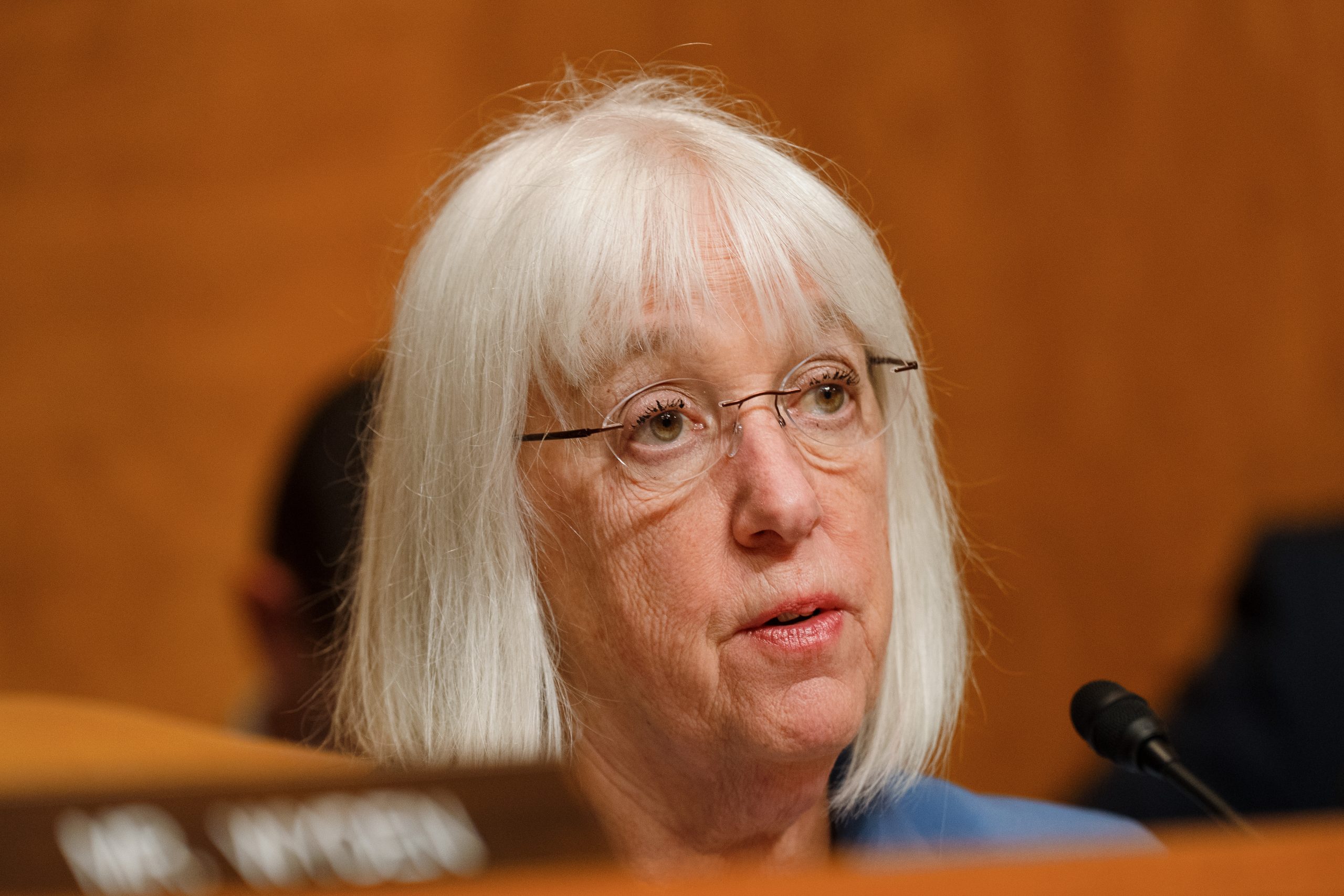
ICYMI: Senator Murray on President Trump’s FY27 Budget Request
Pressed on whether gas will dip to $3/gallon again before the end of the year, Wright says: “Nobody can offer guarantees about the future.”
***WATCH AND READ: Senator Murray’s opening remarks***
***WATCH: Senator Murray’s full questioning***
Washington, D.C. — Today—during a Senate Appropriations Energy and Water Development Subcommittee hearing on President Trump’s fiscal year 2027 budget request for the Department of Energy—U.S. Senator Patty Murray (D-WA), Vice Chair of the Senate Appropriations Committee and Ranking Member of the Subcommittee, pressed Energy Secretary Chris Wright on the Trump administration’s failure to lower energy costs—and its proposal to gut key energy programs communities count on.
[HANFORD CLEAN UP]
Senator Murray began her questioning by pressing Secretary Wright on the budget’s proposal to abandon the Hanford cleanup site in Washington state, with an over $400 million cut overall, noting that it costs more in the long run to cut corners on nuclear waste cleanup.
MURRAY: Mr. Secretary, last year, nuclear waste was turned into glass at scale for the first time at Hanford’s DFLAW facility. Your budget would actually bring that novel work to a screeching halt and fail to meet the holistic agreement that has legally binding milestones.
I have fought with every administration since I got here over Hanford, and anything done in the cover of the night—without support from the State, always, always, ends up back in the courtroom, costing taxpayers more and delaying progress at the site.
When you and I met for the first time, I asked if you would commit to the holistic agreement and working with—not against—Washington state on the cleanup. And you said you wanted time to review carefully and have an EM manager in place. That was 15 months ago, you now have one in place.
So, I want to ask you, do you commit now to meeting the terms and milestones in the holistic agreement?
WRIGHT: We are hugely committed to driving the cleanup process forward. We are doing nothing to slow down or hurt DFLAW, as implied in your question. In fact we are going to use some AI technology to figure out how we can optimize the operation of that plant. The Hanford cleanup is our number one responsibility of our environmental management—
MURRAY: I have not seen any plan to use AI on the DFLAW facilities. Is that some plan on a futuristic point some place? Because that cleanup has to happen now.
WRIGHT: It’s in our budget, but of course we are working on the cleanup of this every day. Of course we are committed to cleaning up Hanford. Of course we are committed to cleaning up Hanford.
MURRAY: My question was, will you meet the moral obligations to support the Hanford cleanup?
WRIGHT: Yes.
[SKYROCKETING ENERGY COSTS]
Senator Murray pressed Secretary Wright on President Trump’s proposal to gut programs that help Americans save money and lower costs as this administration’s policy jack up energy costs.
MURRAY: Mr. Secretary, people are getting hammered by skyrocketing energy costs because of this administration’s policy.
The average price of gasoline right now is four dollars and four cents—it’s higher than that where I live. That is the highest it’s been in four years.
Electricity costs are up 6.9% over the last year—that’s more than double the inflation rate.
And your budget seeks to straight up eliminate programs that really help people save money, I mentioned it before, the Weatherization Assistance and State Energy programs. Meanwhile, you’re asking to spend $7.4 billion on nuclear weapons.
You recently said that gas prices may not go below $3 a gallon until sometime next year.
President Trump said you’re “totally wrong.” Do you stand by your comment that prices may not go down until next year?
WRIGHT: Look, prices have moved down over the last nine or ten days. We do everything we can every day to drive down the price of gasoline. They were below $3 a gallon before engagement in solving a 47-year-old problem, and in the middle of fixing a sticky problem in the center of energy production in the Middle East, gasoline prices today are still a dollar lower than they were in the middle of the Biden administration where they weren’t fixing any sticky problems. Do we want to see it go lower? Absolutely. Are we working every day to get them lower? Absolutely.
MURRAY: We are a year and a half into the Trump administration, so let me just ask you, will you guarantee that gas will go back to $3 again before the end of the year?
WRIGHT: No one can offer guarantees about the future, but of course everything we are doing to grow the supply of energy, and end the Biden administration’s war on hydrocarbons. The Biden administration massively drove up energy prices, and you’re right it’s taken us some effort to bring them back down, but they’re going down.
MURRAY: So, now we depend on oil and here we are.
[CANCELLATION OF ENERGY PROJECTS IN BLUE STATES]
Senator Murray pressed Secretary Wright on the Trump administration’s mass cancellation of energy projects in exclusively blue states in an act of naked political retribution.
MURRAY: Mr. Secretary, last fall—when the president was explicitly threatening retribution against Democrats, his budget director announced he was cancelling $8 billion in energy projects. And he then proceeded to list out 16 Democratic states that were affected. Each of the states voted for Kamala Harris and they each had two Democratic Senators.
So afterward, your Department announced the cancellation of 321 projects. You killed two massive new hydrogen hubs in the Pacific Northwest and California. But you didn’t cancel one in Texas—seems kind of weird to me!
Let me just say, in court, your lawyers admitted that “a primary reason for the selection of which DOE grant termination decisions was whether the grantee was located in a ‘blue state.’” It is plain as day that is a political decision—your own lawyers admitted that in court. And a District Court recently ruled that your cancellations were discriminatory and violated the Fifth Amendment.
So, moving forward, I want to ask you, will you guarantee that it’s a state’s voting history or partisan lean will not be considered when making decisions about grants and awards?
WRIGHT: We evaluated 2,271 projects and politics and voting history played no role in any of the 2,271 decisions we made.
MURRAY: That is not what your own lawyers admitted in court.
WRIGHT: That’s simply not true. You have got to read your own thing you’re quoting from. It was the timing of the announcements, not the decisions we made. The decisions we made were blind on politics and number two, the state—
MURRAY: Blind on politics when they’re all blue states? I don’t understand what you are talking about.
WRIGHT: That were announced at that time, not the decisions made.
MURRAY: What did announcing have to do with red or blue?
WRIGHT: That’s what it says in the statement that you are reading.
MURRAY: No. Okay well, Mr. Secretary—
WRIGHT: No politics were involved in any of our decisions and evaluating.
MURRAY: I find that very hard to believe, and so did the court.
[CLOSING COMMENTS]
MURRAY: Thank you, Chair Kennedy. I think this was a really good discussion on behalf of everybody. I think we have a real challenge in front of us to put our appropriations bill together.
For me, the extreme cuts and extreme war spending are unacceptable, and the last thing we need to do is have a budget that slashes programs that bring down energy costs for families, but that’s what they want us to do.
So, I hope we can work together in a bipartisan way and reject the blueprint in front of us, and work together to listen to our colleagues and come together with a bipartisan bill.
###